Sideshow Prevention Efforts
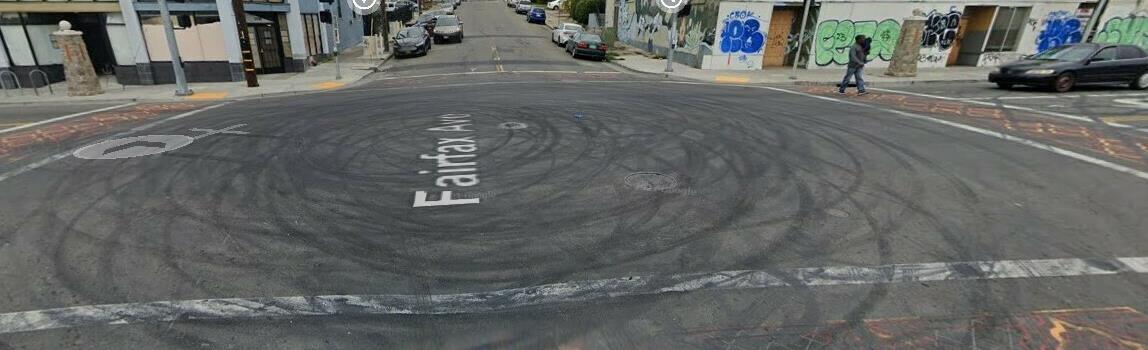
Sideshows and related dangerous driving behaviors including "donuts" are a significant safety and quality of life concern for Oakland residents - as well as the region, are impacting our streets, and are a vexing challenge for local governments.
See Director Rowan Spotlight Recent Pilot Efforts
Background
There is no established best practice or evidence of effective engineering treatments to prevent this type of dangerous driving behavior, and any of the hundreds of intersections in Oakland are theoretically a potential location for sideshows, "donuts" or stunt driving. The City of Oakland has been working with agencies throughout the region to develop, test and implement strategies to mitigate this growing concern.
Because there are no established best-practice strategies to prevent sideshows, the City has embarked on an inter-departmental pilot led by the Oakland Police Department (OPD) and the City Administrator's Office with support from the Oakland Department of Transportation (OakDOT) to pilot engineering strategies to support enforcement efforts at some of the most impacted intersections in Oakland. Proactive enforcement tools and creative legislation lead the way to address sideshows, with engineering complementing a multi-faceted approach.
OakDOT has led the nation with this innovative work to deter sideshows, which initiated beginning in 2021 and continues to evolve with support from City leadership to help address this issue that adversely impacts on the safety and quality of life of Oakland communities.
Engineering treatments will continue to balance the need for deterring sideshows with preserving the functionality of our streets for all road users.
Treatments
The sideshow prevention pilot has focused primarily on reducing the amount of open paved space available at intersections, thereby reducing the uninterrupted area for cars to drift. This has been accomplished by installing vertical elements in the intersection that have safety co-benefits such as channelizing traffic and encouraging slow turns. Treatments to reduce open space typically include traffic islands, and “hardened centerline” (explained below in the FAQ). The pilot has primarily installed treatments using quick build material such as safe hit posts(JPG, 74KB) with supplemental pavement markings.
It is not possible to reduce the amount of open space at every intersection significantly enough to deter sideshows, as these treatments may only be installed where the built environment and roadway geometry allow for a reduction in available space while still accommodating regular traffic including large vehicles that need enough space to turn, such as buses, delivery trucks, and fire trucks.
OakDOT is now exploring piloting treatments to alter the street surface at intersections where it is not possible to reduce the amount of open space in the intersection significantly using safe hit posts or other physical treatments.
Pilot Projects Locations & Timeline
Updated: February 2026
The locations of engineering treatments to try to deter sideshows/donuts/dangerous driving in Oakland are summarized below, along with their current status.
- 35th Ave/MacArthur Blvd: Installation was completed in July 2021.
- Fairfax Ave/Foothill Blvd: Installation was completed in August 2021.
- High St/MacArthur Blvd: Installation was completed in October 2021.
- *42nd Ave under I-880 (known as "the Pit"): Caltrans' installation was completed in June 2022.
- Seminary Ave/MacArthur Blvd: Installation was completed in August 2022.
- 55th Ave/Foothill Blvd: Installation was completed in August 2022.
- 106th Ave/MacArthur Blvd: Installation was completed in September 2022.
- *42nd Ave/International Blvd: Installation was completed in October 2022.
- MacArthur Blvd/Coolidge Ave: Installation was complete in June 2023.
- 66th Ave/International Blvd: Installation was completed in April 2024.
- Foothill Blvd/Seminary Ave: Installation was completed in June 2024.
- Redwood Rd/Skyline Blvd: Installation was completed in June 2024.
- 82nd Ave/MacArthur Blvd: Installation was completed in August 2022. Following feedback from residents and elected officials, further upgrades were completed in March 2025.
- MacArthur Blvd/Ritchie St: Installation was completed in April 2025.
- Fontaine St/Fontaine Overcrossing: Installation was completed in October 2025.
- 15th Ave/International Blvd: Installation was completed in December 2025.
- 64th Ave/Camden St: Installation was completed in February 2026.
- 55th Ave/Princeton St/Cole St is planned for installation in early 2026.
- East 21st St/21st Ave is planned for installation in 2026, following sewer rehabilitation project***
- 45th St/Market St** is planned for installation in 2026.
- 98th Ave/Bancroft Ave** is planned for installation in 2026.
- Skyline Blvd/Pinehurst Rd/Manzanita Dr/Shepherd Canyon Rd is planned for installation in 2026.
*Intersection is in Caltrans right-of-way and the installation of treatments requires state approval
**At this location we are piloting treatments to alter the roadway surface in 2026
***More locations along E 21st St between 14th Ave and 23rd Ave may be added following paving of the corridor
Frequently Asked Questions (FAQ)
How can my intersection be included in the sideshow prevention pilot?
The City of Oakland recognizes the widespread and pervasive nature of sideshow behavior across the City; however, the City must prioritize the limited resources for sideshow prevention and deterrence for the most impacted locations and relative to other critical safety needs facing Oaklanders. OakDOT has and will continue to collaborate with OPD and City leaders to identify candidate locations based on changing needs and the effectiveness of treatments at previously piloted locations.
The City has set up a category in the City's 311 Call Center and website to specifically track public requests for sideshow prevention measures, and residents are encouraged to utilize 311 for sideshow prevention requests. 311 requests are one of many datapoints to inform the selection of future locations for the pilot.
Is the sideshow prevention pilot effective?
The sideshow prevention pilot's immediate objective is to deter and discourage sideshows at the pilot locations. OakDOT coordinates with OPD to assess whether sideshows are continuing at the pilot locations or whether they are relocating to other locations. In addition to assessing the effectiveness of deterring sideshow behaviors, OakDOT is also monitoring maintenance needs required for these installed treatments and receiving qualitative feedback from stakeholders including our Bicyclist and Pedestrian Advisory Commission.
What is a hardened centerline?

Hardened centerline treatment extending into the intersection
They reduce vehicle speeds while turning, when crashes - including those involving pedestrians - are more likely to occur. This type of treatment must be installed in areas outside of travel paths
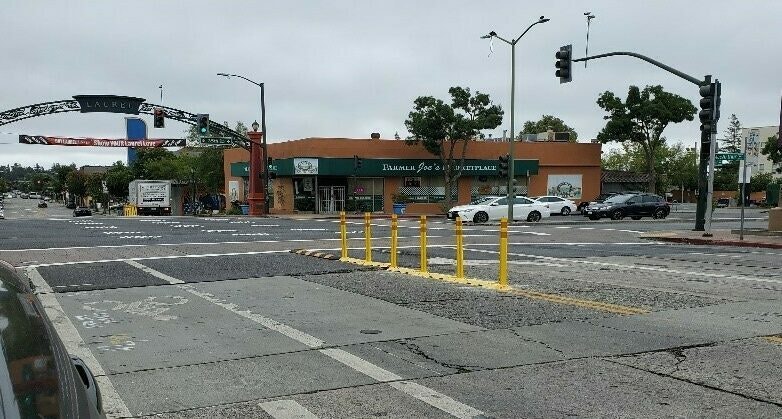
Hardened centerline with safe-hit posts
Preliminary data suggests the effectiveness of hardened centerlines on discouraging sideshows depends on the characteristics of the intersection being treated, and how much we are able to "reduce" the space available for sideshows to occur. This includes the geometry of the intersection and the operation of larger vehicles turning through the intersection such as buses. These characteristics will dictate the length of hardened centerline we can install without impacting the regular flow of traffic, including how far the hardened centerline may extend into the intersection. This will in turn impact how much we are able to "reduce" the space available for sideshows.
What are sideshow prevention installations using steel plates and how do they work?
Steel plates are commonly used on roadway construction projects when excavation is required to repair underground utilities beneath the roadway surface. The steel plates are there to cover the excavated area and allow traffic to continue using the roadway in between construction hours. A small asphalt ramp is typically installed around the perimeter of the steel plates to ramp traffic between the plate and roadway surface.
In June 2024, OakDOT began experimenting with installing steel plates temporarily to interfere with sideshow activity. The goal is to place them in a pattern to disrupt the rotational movement of the back end of an automobile while allowing regular traffic to continue using the roadway. Steel plate warning signs were installed on every approach to the intersection.

Steel Plate Installation at Foothill and Seminary
Why doesn't OakDOT use Bott's Dots?
"Bott's Dots," which are 4-inch ceramic dots, have unfortunately been proven ineffective over time after having piloted them on a limited number of initial installations. Community stakeholder feedback requested the use of Bott's Dots to be put on hold due to the impact on regular traffic, including people bicycling and motorcycling. The City of Oakland Bicyclist and Pedestrian Advisory Commission (BPAC) has expressed concerns with Bott's Dots creating difficult and slippery conditions (especially after rain) for bicyclists and motorcyclists to traverse an intersection, while noting that quick build treatments such as hardened centerlines and traffic islands with safe hit posts did not pose the same challenges. Additionally, Bott's Dots installations have required more maintenance when compared to quick build treatments such as hardened centerline installations. OakDOT is exploring alternative treatments to Bott's Dots to achieve similar alterations to the street surface while avoiding the safety and maintenance challenges of Bott's Dots.